
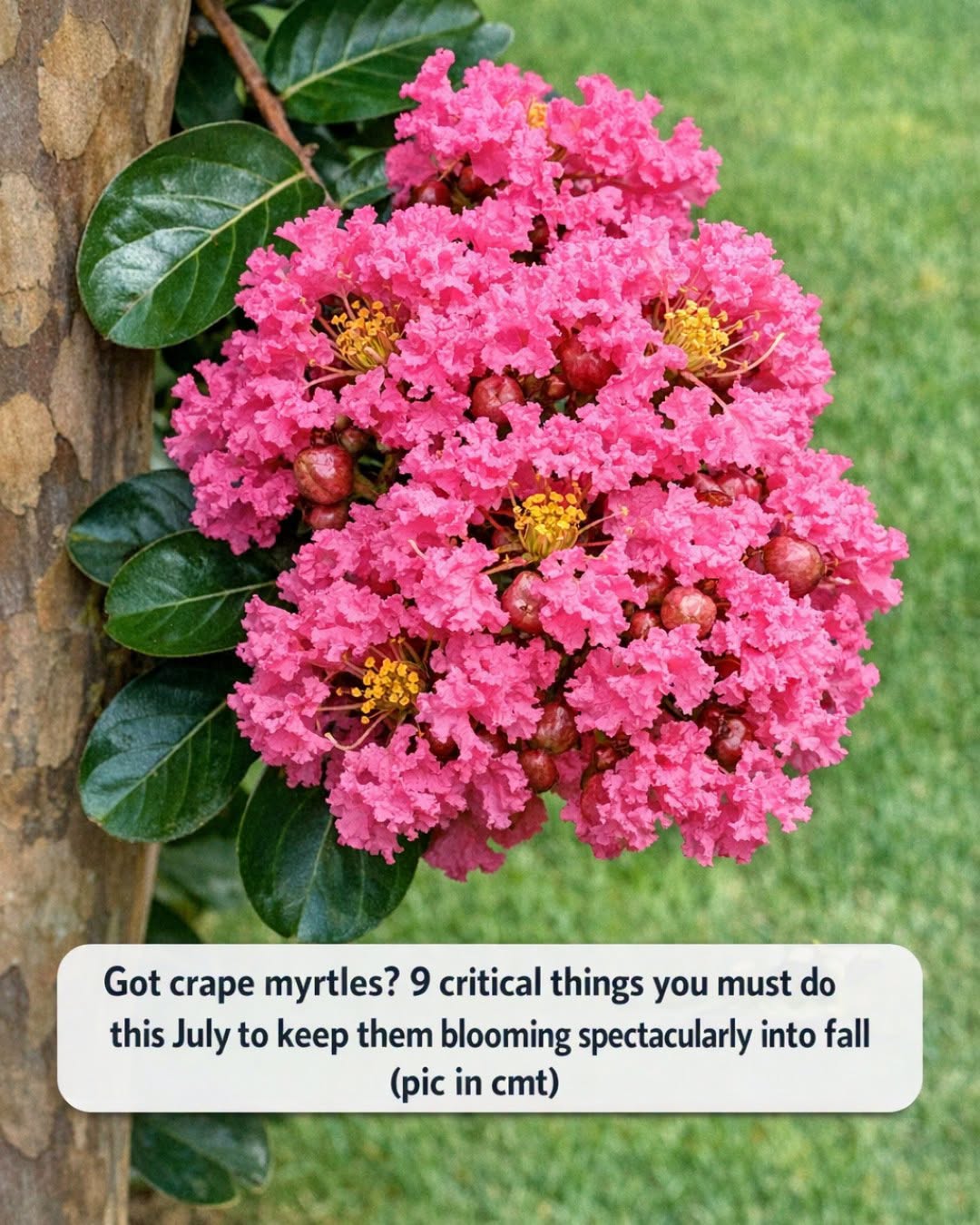
July is when crape myrtles either coast beautifully into a long, flower-filled season or start to look tired, thirsty, and spotty by the time August heat really bears down. I’ve grown them through sticky Southern summers, where a week of blazing sun can push a healthy tree into stress fast, and I’ve learned that midsummer care matters far more than most people think. If you want those big panicles of bloom to keep coming into September and even early fall, July is the month to pay attention.
When I walk my garden this time of year, I’m not doing anything glamorous. I’m checking mulch depth, watching for aphids, snipping seed heads, and making sure I’m not accidentally encouraging weak, floppy growth. The good news is that crape myrtles are tough plants, and a handful of smart, timely jobs can make a dramatic difference. Here’s exactly what I do in July to keep mine blooming hard and looking clean, healthy, and colorful as the season stretches on.
1. Water deeply, but stop the daily sprinkle habit
The biggest July mistake I see is frequent shallow watering. Crape myrtles are drought-tolerant once established, but “drought-tolerant” does not mean “best bloom with no water during a 95°F week.” In July, I’d much rather give a plant 1 to 1.5 inches of water once a week than 10 minutes with a hose every evening. Deep watering pushes roots down 8 to 12 inches into the soil, where moisture lasts longer and the plant stays steadier through heat.
For a newly planted crape myrtle, I check soil moisture every 2 to 3 days. If the top 2 inches are dry, I water slowly at the root zone for 20 to 30 minutes with a hose on a trickle or a drip line. For established shrubs and trees, I usually water every 5 to 7 days during extreme heat, adjusting if I’ve had at least 1 inch of rain. Watering early in the morning, ideally before 9 a.m., helps reduce evaporation and gives foliage time to dry.
2. Refresh mulch to a true 2- to 3-inch layer
By July, spring mulch often has thinned out, washed away, or broken down. I like to maintain a 2- to 3-inch layer of pine bark, shredded hardwood, or pine straw over the root zone. This keeps soil temperatures more even, cuts down on moisture loss, and reduces weed competition right when the plant is trying to keep pushing blooms.
The important part is keeping mulch 3 to 4 inches away from the trunk. I never pile it up like a volcano. That traps moisture against bark, invites decay, and can encourage pests. On larger crape myrtles, I mulch as wide as I reasonably can, often in a circle 3 to 5 feet across, because the feeder roots are spread well beyond the trunk.
3. Deadhead spent flower clusters if you want a quicker rebloom
Crape myrtles will often rebloom without help, but removing spent flower heads in July usually speeds things up and tidies the plant dramatically. Once a flower panicle turns brown and starts setting seed, I cut it back just above a set of leaves or a side shoot. That redirects the plant’s energy toward new growth and fresh flower clusters rather than seed production.
I use clean hand pruners and only remove the faded bloom stem, not large woody sections. On smaller varieties, I can deadhead an entire plant in 10 to 15 minutes. On larger trees, I focus on reachable branches and let the upper canopy do its thing. If I deadhead in early to mid-July, I often get a stronger second flush by late summer than I would if I ignored the plant completely.
4. Do not commit “crape murder” in midsummer
I’m blunt about this one because it matters: July is not the time for hard pruning. Topping crape myrtles by cutting back major branches creates ugly knobs, weak water sprouts, and fewer elegant blooms over time. It also puts the plant under unnecessary stress during the hottest stretch of the year.
If you need to prune in July, keep it light and purposeful. Remove only dead wood, broken twigs, crossing shoots, basal suckers, or spent bloom stems. Save structural pruning for late winter, when the framework is visible and the plant is dormant. A crape myrtle that keeps its natural shape will almost always look better and perform better than one hacked into blunt stubs.
5. Feed lightly only if the plant truly needs it
July is not the moment for a heavy dose of high-nitrogen fertilizer. Too much nitrogen now can produce lush leafy growth at the expense of flowers, and that soft new growth is more likely to attract aphids and struggle in heat. If my crape myrtle has decent leaf color, is blooming, and has put on normal growth, I skip feeding altogether in midsummer.
If a plant is pale, growing poorly, or was planted recently in poor soil, I use a very light application of a balanced slow-release fertilizer, something close to 10-10-10 or 5-10-5, at no more than half the label rate in July. For a medium shrub, that might be 1/4 to 1/2 cup scattered evenly around the drip line, then watered in well. Even better, I top-dress with 1 inch of compost, which feeds more gently and improves soil over time.
6. Inspect for aphids and the sticky mess they leave behind
If you notice shiny, sticky leaves, black sooty mold, or ants crawling over your crape myrtle, aphids are usually the culprits. July is prime time for them. They gather on tender new growth and undersides of leaves, sucking sap and excreting honeydew. The mold that follows looks awful, even when the plant is otherwise healthy.
I start simple. A strong spray of water from the hose, aimed upward into the foliage in the morning, can knock a lot of aphids off. If that doesn’t do enough, I use insecticidal soap or horticultural oil, making sure to coat the undersides of leaves and avoiding application when temperatures are above about 85°F to 90°F, depending on the product label. I also try not to wipe out beneficial insects; lady beetles and lacewings can clean up an aphid outbreak better than most people expect.
7. Watch for powdery mildew and leaf spot, especially in humid weather
Older crape myrtle varieties can be prone to powdery mildew, and in muggy July weather I also keep an eye out for Cercospora leaf spot. Mildew shows up as a whitish, dusty coating on new growth and flower buds. Leaf spot usually appears as dark speckling or blotches that can lead to early leaf drop from the lower canopy upward.
The first line of defense is cultural, not chemical. I avoid overhead watering late in the day, thin only lightly if air circulation is terrible, and rake up heavily infected fallen leaves. If a plant has had repeat disease issues, I make a note to replace it eventually with a resistant cultivar rather than spending every summer fighting the same battle. In severe cases, a labeled fungicide can help, but timing and coverage matter, and it’s usually more effective when started early rather than after the plant is already heavily affected.
8. Pull suckers from the base before they steal energy
Many crape myrtles send up suckers from the base or roots in summer, especially if the plant was stressed, pruned hard, or planted shallowly. If I want a tree form, I remove these shoots as soon as I see them. They take energy away from the main canopy and can turn a clean, multi-trunk specimen into a thicket surprisingly fast.
I don’t just clip them halfway. I trace each sucker down and cut it as close to the point of origin as I can with clean pruners. On a mature plant, I check every 2 to 3 weeks in July and August. Staying on top of this is much easier than letting shoots harden off and trying to fix a messy base later.
9. Keep the root zone weed-free so blooms don’t compete for moisture
Weeds are more than an eyesore in July. Grass, nutsedge, spurge, and other summer weeds compete directly for water and nutrients during the hottest, driest part of the season. Around a blooming crape myrtle, that competition can mean fewer flowers, more stress, and crispy leaf edges when heat builds.
I keep a clean ring around the base, at least 18 to 24 inches wide on smaller plants and much wider on larger specimens. Hand-pulling after rain is easiest, and a mulch layer helps prevent new weeds from getting started. I’m careful not to gouge the soil deeply with a hoe, because crape myrtles have feeder roots close to the surface.
10. Protect blooms from drought stress during heat waves
There’s regular July heat, and then there are those brutal stretches of 98°F to 102°F with hot wind and no rain for 7 to 10 days. During those periods, even established crape myrtles can abort buds, shorten bloom cycles, or develop scorched leaf margins. When I know a heat wave is coming, I water deeply the day before or early on day one, rather than waiting until the plant looks stressed.
Container-grown crape myrtles need even closer watching. In black nursery pots or dark decorative containers, root temperatures can soar. I’ve had potted crape myrtles need water every day in July, sometimes twice a day during extreme heat if the pot was under 16 inches wide. A container at least 20 to 24 inches across, filled with a well-drained potting mix, performs much more steadily.
11. Remove seedpods and weak interior shoots on repeat-blooming varieties
Some cultivars are naturally better rebloomers than others, but nearly all benefit from a little midsummer tidying. Besides deadheading, I remove a few weak, twiggy interior shoots that clearly won’t support quality blooms. I’m not talking about thinning the whole plant, just snipping out skinny, shaded growth that clutters airflow and wastes energy.
On vigorous varieties, I also remove forming seedpods where practical after the first flush fades. This is especially worthwhile on smaller ornamental forms where you can reach most of the canopy. It’s a small job, but in my experience it can noticeably sharpen the second round of flowering.
12. Check bark and branches for scale if leaves look dingy all summer
If your crape myrtle looks perpetually off-color, sticky, or moldy even when aphids aren’t obvious, inspect the bark for crape myrtle bark scale. It appears as white to gray, felted bumps on branches and trunks, often in crotches and rough bark areas. This pest has become much more common in many regions and can weaken the plant over time.
I carry a glove or tissue and gently scrape one spot. If it leaves behind pinkish fluid, that’s a strong clue you’re dealing with scale. Management may involve washing reachable areas, improving plant vigor, and using a systemic or other treatment labeled for bark scale at the correct timing. Because local recommendations vary by region, I always check with the cooperative extension service in my state before treating heavily.
13. Support young plants, but don’t baby them too much
First-year crape myrtles need a little extra July attention. I watch them more closely for drought stress, make sure the mulch ring stays broad, and check that the root ball hasn’t dried out faster than surrounding soil. A newly planted 5-gallon or 15-gallon specimen can go from fine to wilted in 48 hours during a dry spell.
That said, I don’t coddle them with constant fertilizer or daily shallow watering. The goal in the first summer is root establishment, not explosive top growth. Slow, steady growth with good leaf color and a few blooms is a better sign than a lot of lanky, soft shoots that flop or scorch by August.
14. Choose your late-summer strategy now: maintain, reshape lightly, or replace later
July is when I decide whether a crape myrtle is simply tired from weather or whether it has a bigger issue such as poor siting, chronic disease, or an outdated mildew-prone cultivar. If the plant gets fewer than 6 hours of direct sun, for example, no amount of deadheading will make it bloom at its best. Crape myrtles really want full sun, and 8 hours is even better for heavy flowering.
If the plant is healthy but a little overgrown, I make a note for selective winter pruning rather than doing anything drastic now. If it has struggled for several summers, I start researching replacements bred for disease resistance and better habit. Sometimes the most useful July task is simply honest evaluation. A well-sited modern cultivar can bloom circles around an old problem plant with less work, less spraying, and far less frustration.
ADVERTISEMENT
