
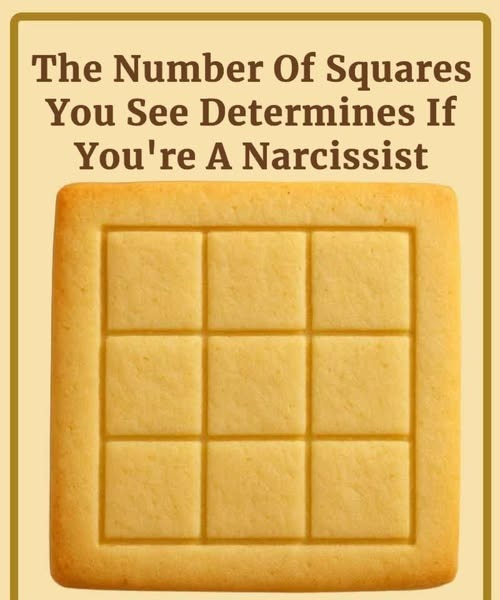
✅ What Your Answer Actually Reveals About You
Depending on how many squares you saw, here’s what might have happened:
💡 Factors that influence your count:
-
- Attention span
- Experience with puzzles
- Cognitive flexibility
- Time spent analyzing
- Stress or fatigue levels
📌 None of these are linked to narcissism.
❌ Debunking the Narcissism Myth
Narcissistic Personality Disorder (NPD) is a clinical diagnosis defined by the DSM-5 (Diagnostic and Statistical Manual of Mental Disorders). Traits include:
-
- Grandiosity
-
- Need for excessive admiration
- Lack of empathy
- Exploitative behavior
- Sense of entitlement
These cannot be measured by counting shapes.
🧠 Real assessments use structured interviews and validated tools like:
-
- The Narcissistic Personality Inventory (NPI)
- The Personality Assessment Inventory (PAI)
And even then, only trained professionals should interpret results.
🧠 Why Did This Viral Hoax Spread?
Because it plays on two powerful human tendencies:
- Curiosity: We love learning about ourselves
- Social sharing: People post their answers to prove they’re “not narcissists”
But turning a brain teaser into a personality test is misleading — even when meant as a joke.
🎯 Fun Ways This Puzzle Can Be Useful
While it won’t diagnose anything, it can help:
🧩 Try it with friends — and skip the fake psychology.
Final Thoughts
You don’t need to worry if you only saw 9 squares.
But you should smile at how much fun our brains have with a simple grid.
So next time you’re scrolling past a viral “personality test”… pause.
Laugh. Share. But don’t believe everything that says it knows you better than you know yourself.
Because real self-awareness isn’t found in cookies or clickbait. It grows — slowly, thoughtfully, and honestly.
And that kind of insight? It takes more than counting squares.
ADVERTISEMENT
